Wishing all of you a very Happy New year!
Cheers
Aparna

31 December, 2005


30 December, 2005
A morning ritual
“What took you so long?” She asked
With an impatient toss of her head
He knew it would be death to answer
So he stared at his fingers instead
He had just finished reading
Of a romantic ride across time
So his mood was really mellow,
Heart full of emotions sublime
He had been so preoccupied
With thoughts of the unheard call
That urgency of the voice nearby
He had not heeded at all
Now of course it was clear
There would be hell to pay
He was sure of it because
It happened every other day
He tried hard to focus
To lend her his ear
And then finally her voice
Broke out in the clear
“Everyday it’s the same story, so
If this is what you’ll continue to do
I’m moving in with my parents
Unless you build another loo!”
:-))
With an impatient toss of her head
He knew it would be death to answer
So he stared at his fingers instead
He had just finished reading
Of a romantic ride across time
So his mood was really mellow,
Heart full of emotions sublime
He had been so preoccupied
With thoughts of the unheard call
That urgency of the voice nearby
He had not heeded at all
Now of course it was clear
There would be hell to pay
He was sure of it because
It happened every other day
He tried hard to focus
To lend her his ear
And then finally her voice
Broke out in the clear
“Everyday it’s the same story, so
If this is what you’ll continue to do
I’m moving in with my parents
Unless you build another loo!”
:-))
Reflection
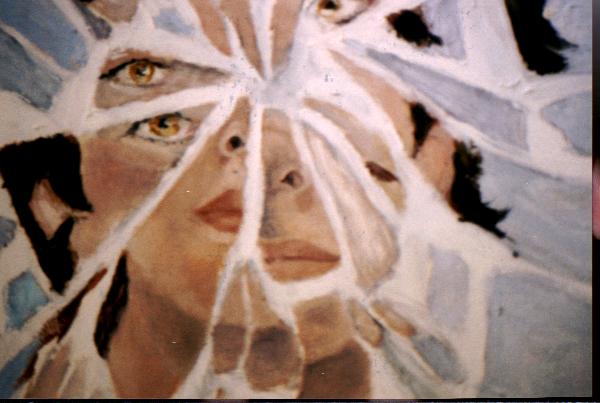
And when I let go
The mirror cracked side to side
Myriad faces seen
...I wonder, which one is me?
29 December, 2005
Building walls
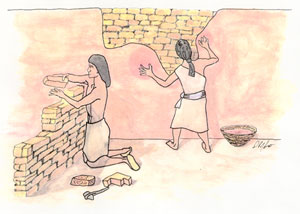
“I have nothing more to say to you. Words fail me,” she said and stomped off ending the argument. Silence reigned. Not the warm glowing silence that envelopes two people who are so comfortable with each other that they can live companionably without filling every nook and cranny with their voice. No, this was a cold dark frosty silence. For a while it creaked with the tension and bitterness of the unspoken verbal duel and then with time lapsed into more or less a total disconnect between the two people concerned.
Yes, I do believe silence comes in different forms, one of which is our inability to reach out and connect with another human being. Is it a failure of words or is it simply borne out of some fear deep within?
“Why don’t you just tell him what you feel, rather than keeping quiet about it?” I asked a friend, who was living through a strained relationship in stoic silence. “Things will only get worse then. Atleast this prevents ugliness.” I asked her why she assumed that things would get ugly if she spoke her mind, just what she felt. “Oh well, we never can stick to just sharing our feelings, we end up blaming each other and it leads to terrible fights. I am so tired of these fights that I prefer it this way. It atleast has the pretence of being peaceful. Stifling is better than aggression. Anyway I have no choice. The alternative is much more terrifying. ”
This silence results from our fear. Fear of the consequences we imagine will arise on expressing what we really think and feel. Most often it is the fear of losing something, be it an argument or a person we love. Or it could even be the fear of discovery – the discovery that we are not what we, till now, had projected/believed ourselves to be. But at the core, it is often our fear of being rejected, ridiculed, a loss of power and/or a fear of failure.
In Bergman’s ‘Silence’ we are treated to this desperate need to communicate and the underlying fear. The young boy Johan entertains his aunt Ester with a puppet who speaks a funny tongue. When questioned why he speaks funny, Johan replies, “Because he is afraid.” This theme of fear is continued in ‘Persona’, where Elizabeth, an actress is suddenly left in a speechless limbo as language fails her altogether.
A friend and I never seemed to agree on our views on Freud. We argued for a few days and then one day I said, “let Freud be a taboo topic between us.” And so it was. Then one day, while talking about something else, he said, “just like we do not discuss Freud, we will not discuss this.” I realized something very important that day. This is how walls are built. Soon there will be many issues ‘not to be discussed’. We will not be able to share freely for there will be censor at work, trying to skirt politely around various issues. Conversations will be more like trying to walk safely through a minefield, dreading that at any moment we may step on and trigger a mine of argument. And who knows, finally, if we get tired of being on guard all the time, the wall will become insurmountable? Will there be silence then?
When we cannot communicate freely, when we do not find the right words to reach out and touch one another, is it the beginning of the end? Does fear get to win in the end? I would like to believe otherwise; that we have the grace to live life with courage. For after all, as someone rightly said, courage is not the absence of fear. It is plodding through our fears with the realization that something else is more important.
The next time we chat, I will tell my friend that we can discuss Freud as well - and will not be afraid of a good argument.
Yes, I do believe silence comes in different forms, one of which is our inability to reach out and connect with another human being. Is it a failure of words or is it simply borne out of some fear deep within?
“Why don’t you just tell him what you feel, rather than keeping quiet about it?” I asked a friend, who was living through a strained relationship in stoic silence. “Things will only get worse then. Atleast this prevents ugliness.” I asked her why she assumed that things would get ugly if she spoke her mind, just what she felt. “Oh well, we never can stick to just sharing our feelings, we end up blaming each other and it leads to terrible fights. I am so tired of these fights that I prefer it this way. It atleast has the pretence of being peaceful. Stifling is better than aggression. Anyway I have no choice. The alternative is much more terrifying. ”
This silence results from our fear. Fear of the consequences we imagine will arise on expressing what we really think and feel. Most often it is the fear of losing something, be it an argument or a person we love. Or it could even be the fear of discovery – the discovery that we are not what we, till now, had projected/believed ourselves to be. But at the core, it is often our fear of being rejected, ridiculed, a loss of power and/or a fear of failure.
In Bergman’s ‘Silence’ we are treated to this desperate need to communicate and the underlying fear. The young boy Johan entertains his aunt Ester with a puppet who speaks a funny tongue. When questioned why he speaks funny, Johan replies, “Because he is afraid.” This theme of fear is continued in ‘Persona’, where Elizabeth, an actress is suddenly left in a speechless limbo as language fails her altogether.
A friend and I never seemed to agree on our views on Freud. We argued for a few days and then one day I said, “let Freud be a taboo topic between us.” And so it was. Then one day, while talking about something else, he said, “just like we do not discuss Freud, we will not discuss this.” I realized something very important that day. This is how walls are built. Soon there will be many issues ‘not to be discussed’. We will not be able to share freely for there will be censor at work, trying to skirt politely around various issues. Conversations will be more like trying to walk safely through a minefield, dreading that at any moment we may step on and trigger a mine of argument. And who knows, finally, if we get tired of being on guard all the time, the wall will become insurmountable? Will there be silence then?
When we cannot communicate freely, when we do not find the right words to reach out and touch one another, is it the beginning of the end? Does fear get to win in the end? I would like to believe otherwise; that we have the grace to live life with courage. For after all, as someone rightly said, courage is not the absence of fear. It is plodding through our fears with the realization that something else is more important.
The next time we chat, I will tell my friend that we can discuss Freud as well - and will not be afraid of a good argument.
It's only words
Words! Words! Words! I'm so sick of words!
Never do I ever want to hear another word.
There isn't one I haven't heard.
~Eliza Doolittle in My Fair Lady
The Bible proclaimed, “In the beginning was the Word.” Since then, many words have been spoken. Words are the tools with which we express our thoughts and emotions, our means to communicate with one another. However, as Voltaire pointed out, many a time they also act as an effective mask behind which we hide ourselves.
I sometimes wonder at the words we use in our daily lives, those that allow us to sound intelligent and be vague at the same time, once the hallmark of a bureaucrat. They always remind me of the speeches made by the pragmatic and wily Sir Humphrey and the bewildered expression of Jim Hacker in the ‘Yes Minister’ series.
Why do we sometimes hide behind our words? Why are we unable to communicate even if we have a whole host of words to string? Does the thought of opening up and revealing our inner selves to another person scare us to such a point?
In his book ‘Images – My life in film’, Ingmar Bergman talks about this mask rather eloquently while describing his relationship with Kabi Larete. He says:
Sometime ago, I watched Bergman’s ‘Autumn Sonata’, where he had made use of this personal realization.Between the two of us, we had developed a complicated staged relationship. We were confused and at the same time exceptionally fond of each other…we spoke about everything and anything that occurred to us. But in reality we had no common language. We couldn’t communicate.
The more Kabi and I watched the erosion of the collaboration into which we put so much effort, the more we tried to improve it with verbal cosmetics.
In the film, Victor, while conversing with his wife Eva, says to her “I nurture some unrealistic dreams and expectations, and some kind of longing too for that matter. I long for you.” To which Eva replies, “Those are beautiful words, aren’t they? I mean they are words that don’t mean anything real. I was raised on beautiful words. The word ‘pain’ for instance. Mother was never mad or disappointed or unhappy; she ‘felt pain’. You too have a lot of words like that.”
Maybe someday we will feel safe enough to connect with one another without creating a barrier of words? I sincerely hope so…
27 December, 2005
The sound of silence
******************
"Experience teaches us that silence terrifies people the most."
Bob Dylan
******************
He enters the classroom, sits down, doesn't say anything. he looks at us, we look at him. At first there are a few giggles, but Morrie only shrugs, and eventually a deep silence falls and we begin to notice the smallest sounds, the radiator humming in the corner of the room, the nasal breathing of one of the fat students.
Some of us are agitated. When is he going to say something? We squirm, check our watches. A few students look out of the window, trying to be above it all. This goes on a good fifteen minutes, before Morrie finally breaks in with a whisper.
"What's happening here?" he asks. And slowly a discussion begins - as Morrie has wanted all along - about the effect of silence on human relations. Why are we embarrassed by silence? What comfort do we find in all the noise? (An extract from 'tuesdays with Morrie' by Mitch Albom)
I put down the book. How true it was! We were so often embarrassed by a lull of silence in our conversations. Just think of a social evening. At some point the buzz of conversation dies down and there is silence in the air. How uncomfortably it seems to hang - and most people squirm, trying to quickly think up a topic or a joke to break "the ice" so to speak. Then someone plunges in, and there is a mild sigh of relief all around. The evening goes on.
And what about one-on-one interactions? Oh that's even more tough! A friend returned from a date completely flustered. "How did it go?" I asked. "Oh he maybe a wonderful guy but he is too quiet, it was quite tiring really," she replied. Then she went on to explain. The man in question was wonderful to talk to (when he did talk, that is). But during their chats, there were some moments of silence. He was quite ok with that, quietly drinking his coffee but unfortunately my friend was not. So everytime such a moment came to pass, she jumped right in filling the silence with small talk - anything from telling him about her childhood, her friends, some funny incident at home - anything at all. To all of that he quietly smiled and let her go on. The result was that by the end of the evening, she had done almost all the talking and was tired. Furthermore, while she had told the man much more than probably he wanted to know about her on their first date, she did not get to know him at all! When I pointed this out to her, she wailed "but how could I get to know him - he was so silent and uncommunicative! I was afraid he was getting bored"
Was it really so? I wondered. I asked another talkative friend of mine - successfully married to a man who comes across as rather serious and quiet when you first meet him. "Well I really wanted to get to know him when we first met," she replied. "So I used to keep quiet and just throw in some questions now and then. I turned a listener!" But what about silences? "Ah well," she said rather philosophically, "I assumed that the silence was as uncomfortable for him as it was for me so if it came to that, he would say something to break it!" What if he was getting bored? "Not my problem. It could be interpreted both ways really. If I was worried that the silence meant I was boring him, he might be thinking the same thing!" Hmm a battle of wills...
As part of our training in Qualitative Research we are taught how to handle silence which may crop up during interviews and group discussions. It is extremely common for a moderator to get all jumpy and anxious if the group lapses into a period of silence. The moderator feels a loss of control and in order to do away with the silence and get the group going again often jumps in with the next question or topic. However in doing so, often vital information remains undiscovered. This is where the training teaches us to react differently.
A good moderator lets the silence hang in the air for a while because the silence could be important data as well. It could mean any of the various things: a)that the respondents are mulling over the issue at hand and need some time to respond b) they have nothing more to say on the matter c) they are bored d) they disagree with some issue but have not bonded well enough to feel free to express their disagreement, so on and so forth. So after letting the silence be, in case no response comes up, the moderator may then throw in some probes to try and understand the nature of the silence before moving on. Also, as is often the case, the respondents are also uncomfortable with silence and one of them is likely to break it and therefore take the discussion forward. So the training allows the moderator to be aware of her anxiety, harness her need to control and let the group process flow more naturally.
But what of the times when we are on our own and are terrified by silence? In such times, silence points out to us our loneliness. Often the TV is a handy escape in such instances. A friend's elderly mother keeps the TV on night and day in her empty house. She says it is her companion. She even sleeps with the TV switched on as it makes her feel there are other people people in the house talking and she is not alone. Asked what would happen if the TV was not there, she replied that then she would be scared of her loneliness as well as the anxious thoughts that would then fill her mind.
So there it is - our silences are often more deafening than our chatter. And we rush to fill it in with words - words that often mean nothing really.
26 December, 2005
A time to share
This blog has been neglected for sometime, a friend of mine pointed out a few days ago. What better time to take care of that than in this season of sharing. Hope to chat and share my thoughts more regularly from now on.
Over the next few days will pen down some of my thoughts on communication. A good place to start is of course with the words of my favourite poet:
A Time to Talk
 When a friend calls to me from the road
And slows his horse to a meaning walk,
I don’t stand still and look around
On all the hills I haven’t hoed,
And shout from where I am, "What is it?"
No, not as there is a time to talk.
I thrust my hoe in the mellow ground,
Blade-end up and five feet tall,
And plod: I go up to the stone wall
For a friendly visit.
 When a friend calls to me from the road
And slows his horse to a meaning walk,
I don’t stand still and look around
On all the hills I haven’t hoed,
And shout from where I am, "What is it?"
No, not as there is a time to talk.
I thrust my hoe in the mellow ground,
Blade-end up and five feet tall,
And plod: I go up to the stone wall
For a friendly visit.
~Robert Frost
photograph by Amit
Subscribe to:
Posts (Atom)